
When people picture the world’s legendary empires, names like the Roman Empire, Alexander’s Empire, or the British Empire often come to mind. But in terms of continuous, unbroken land area, no empire in human history has ever surpassed the Mongol Empire.
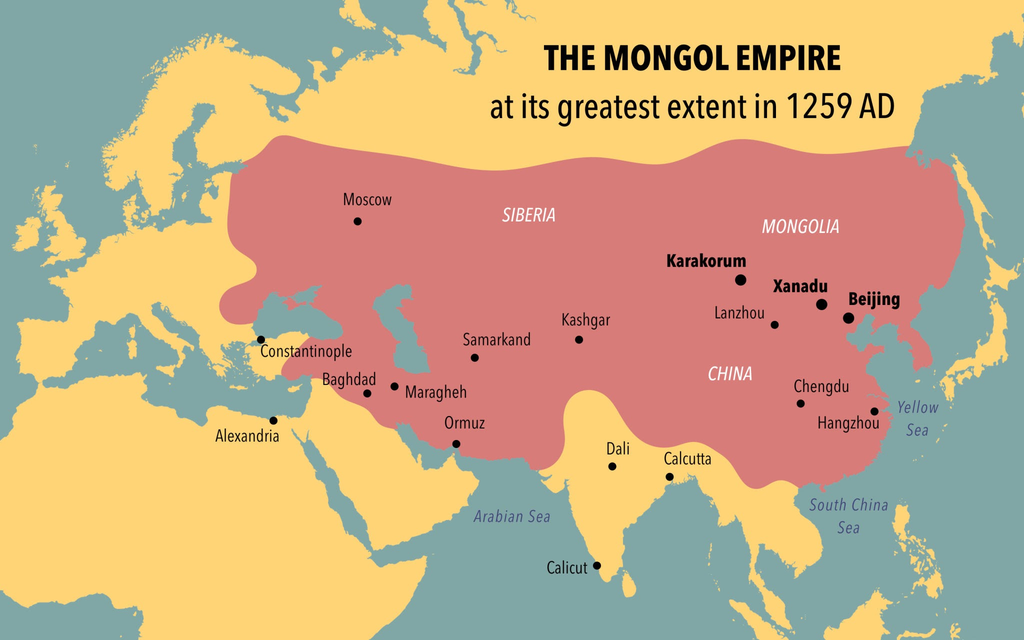
At its peak in the 13th and 14th centuries, the Mongol Empire covered an astounding 24 million square kilometers (9.3 million square miles)—roughly 16% of the Earth’s total landmass.
To put that into perspective, the empire stretched across 6,000 miles (9,700 km) from the Sea of Japan all the way to the Danube River in Central Europe, and from the frozen forests of Siberia south to the Persian Gulf.
Here is an in-depth breakdown of how big the Mongol Empire really was, how its maps evolved across generations, and how you can explore its historic heartland in Mongolia today.
The Scale of the Empire: Mind-Boggling Historical Stats
To truly grasp the territorial sheer scale of the Mongol Empire, it helps to compare its borders with the modern world:
- Total Land Area: ~24 million km² (9.3 million square miles)—nearly twice the size of the modern-day Russian Federation.
- Modern Countries Covered: Today, all or parts of 28 modern nations lie within its historic boundaries, including Mongolia, China, Korea, Russia, Ukraine, Poland, Hungary, Kazakhstan, Uzbekistan, Iran, Iraq, Syria, and Turkey.
- Population Under Rule: Over 100 million subjects—which represented roughly 25% of the global population in the 13th century.
- Contiguous Landmass: Unlike the British Empire, which relied on overseas naval colonies separated by oceans, the Mongol Empire was entirely connected by land. A single messenger on horseback could ride across the entire realm using the Yam postal relay network.
Phase-by-Phase Expansion: How the Map Grew
The formation of history’s largest contiguous land empire happened with staggering speed over less than a century.
1206: Unification of Steppe Tribes (Temüjin crowned Genghis Khan)
└── 1211–1227: Campaigns in Northern China (Jin Dynasty) & Khwarazmian Empire (Central Asia)
└── 1236–1242: Western Campaign (Batu Khan invades Kievan Rus & Eastern Europe)
└── 1258–1279: Middle East Conquered (Hulagu Khan) & Southern Song Dynasty (Kublai Khan)
1. The Foundation (1206)
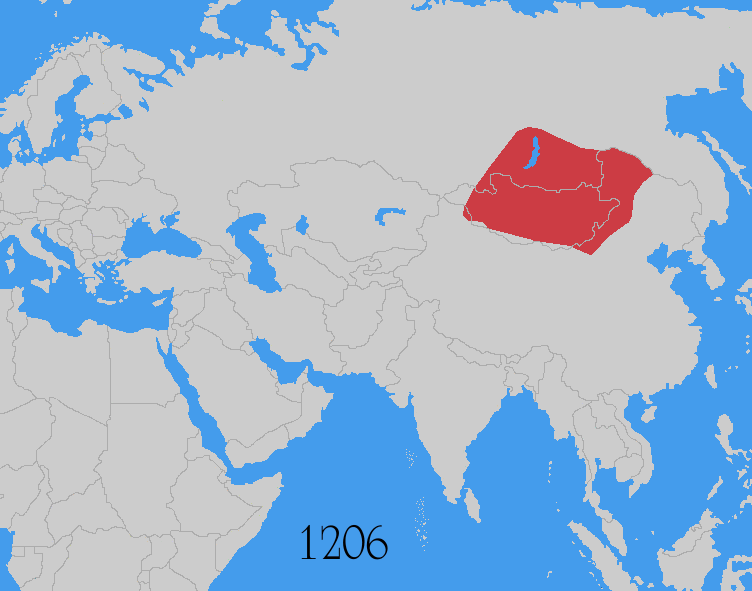
In 1206, near the Onon River, Temüjin united the warring nomadic confederations—including the Khamag Mongol, Merkit, Naiman, Kerait, and Tatars—and was granted the title Genghis Khan. At this point, the young state covered the Mongolian plateau and parts of Southern Siberia.
2. Pushing Across Central Asia & Northern China (1206–1227)
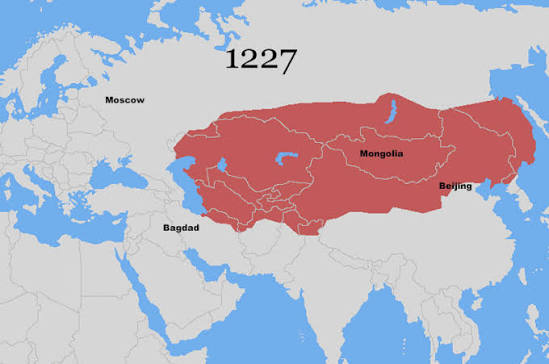
Before his death in 1227, Genghis Khan expanded the borders dramatically:
- East: Annexed the Western Xia (Tangut) and captured the Jin Dynasty capital of Zhongdu (modern Beijing).
- West: In response to the execution of Mongol envoys, Genghis Khan led a devastating campaign against the Khwarazmian Empire, absorbing silk road oasis hubs like Samarkand, Bukhara, and Merv into the empire.
3. The European & Middle Eastern Expeditions (1235–1260)
Under Genghis Khan’s sons and grandsons, the empire reached its territorial maximum:
- The Western Campaign: Batu Khan led the Golden Horde into Eastern Europe, conquering Kievan Rus principalities (Moscow, Kyiv) and defeating allied European armies at the Battle of Mohi (Hungary) and Battle of Legnica (Poland) in 1241.
- The Middle Eastern Campaign: Hulagu Khan established the Ilkhanate, captured Baghdad in 1258, and expanded control across modern-day Iran, Iraq, Azerbaijan, and parts of Syria and Turkey.
- The Conquest of All China: Kublai Khan defeated the Southern Song Dynasty, uniting China under the Yuan Dynasty and establishing Dadu (Beijing) alongside the ancestral capital at Karakorum.
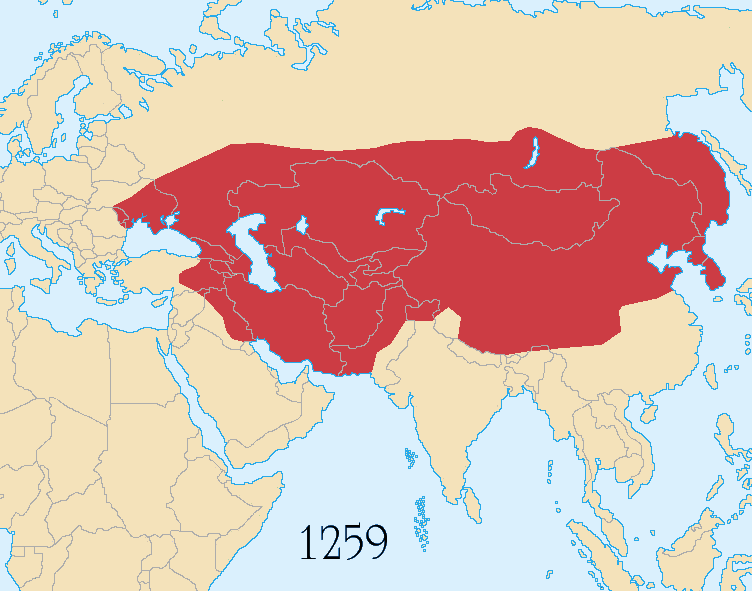
The Four Great Realms (Khanates)
By the late 13th century, to manage such a vast continent, the empire operated as four major connected realms under the supreme authority of the Great Khan (Khagan):
| Realm / Khanate | Primary Regions Covered | Key Historical Cities |
| Yuan Dynasty (Great Khanate) | Mongolia, China, Korea, Eastern Siberia | Karakorum, Khanbaliq (Beijing), Shangdu |
| Golden Horde (Jochi Realm) | Russia, Ukraine, Kazakhstan, Eastern Europe | Sarai, Crimea, Volga Region |
| Ilkhanate | Iran, Iraq, Azerbaijan, Turkey, Afghanistan | Tabriz, Baghdad, Maragheh |
| Chagatai Khanate | Central Asia (Uzbekistan, Kyrgyzstan, Tajikistan) | Samarkand, Bukhara, Kashgar |
Pax Mongolica: How Scale Created the First Global World
The immense territory on the map was not merely a military feat—it established Pax Mongolica (The Mongol Peace).
For over a century, the Mongol administration secured the entire length of the Silk Road. Travelers, scholars, merchants, and diplomats—most notably Marco Polo and Ibn Battuta—could journey safely across Eurasia carrying imperial passports (Paiza).
This geopolitical unity allowed an unprecedented exchange of trade goods, printing technology, medical knowledge, astronomy, and culture between the East and the West.
Visit the Heartland of the Great Empire in Mongolia Today
While the ancient borders have changed over time, the origins, culture, and dramatic landscapes that birthed the Mongol Empire remain preserved in Mongolia.
Key historical sites every traveler should visit:
- Karakorum (Harhorin) & Orkhon Valley: Explore the UNESCO World Heritage valley that served as the capital of the Mongol Empire under Ögedei Khan.
- Chinggis Khaan National Museum in Ulaanbaatar: A world-class museum housing priceless imperial artifacts, original seals, and interactive historical maps.
- The Genghis Khan Statue Complex (Tsonjin Boldog): Stand atop the world’s tallest equestrian statue looking out over the open steppes where Temüjin according to legend found a golden whip.
- Burkhan Khaldun Mountain: The sacred mountain range in Khentii province where Genghis Khan grew up, prayed, and was laid to rest.
Experience History Firsthand with H&A Travel
Want to walk through the landscapes where world history was shaped?
At H&A Travel, our expert local guides bring the history of the Mongol Empire to life. From UNESCO-listed cultural valleys and ancient capital ruins to authentic ger camp stays on the open steppe, we create seamless, unforgettable journeys across Mongolia.